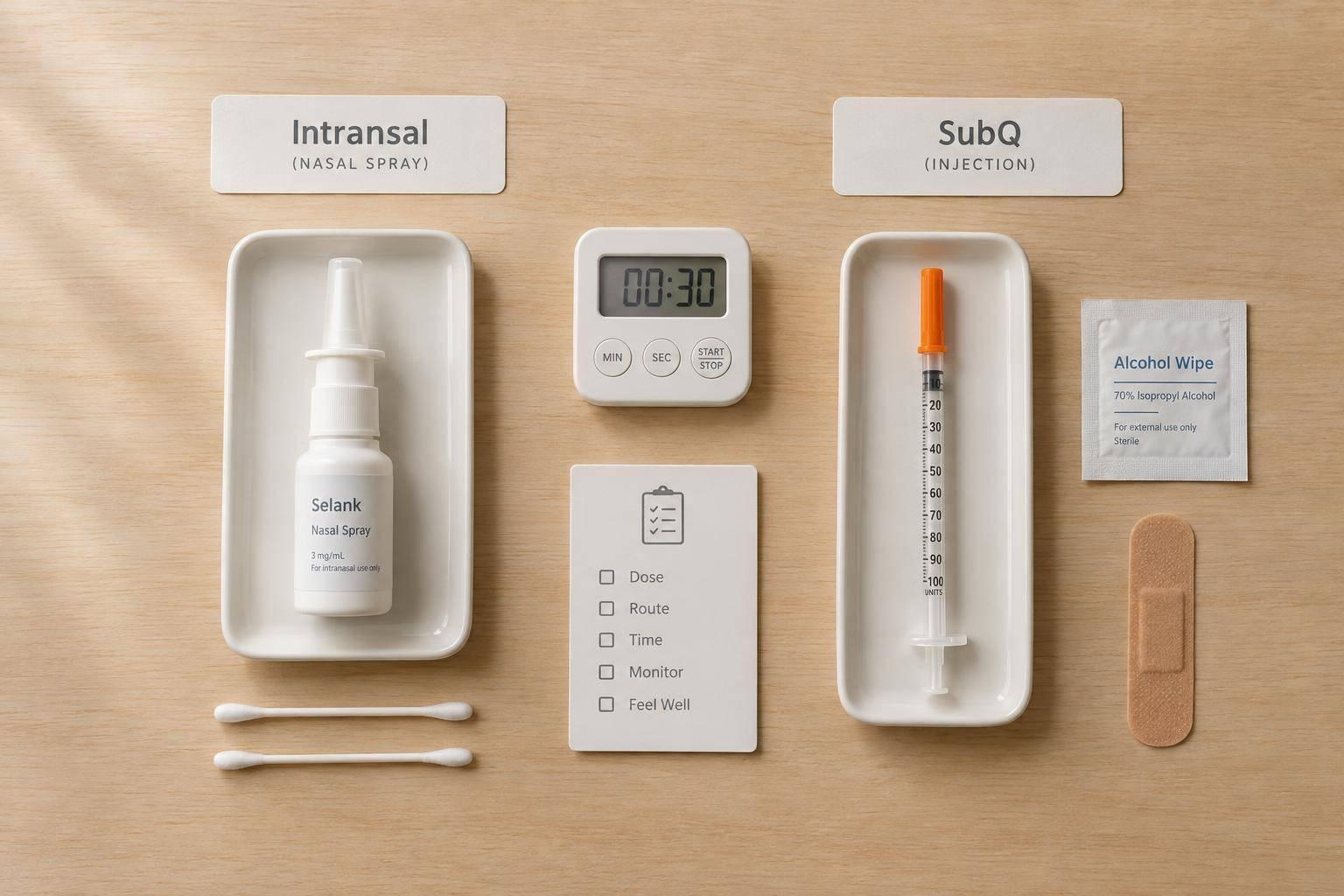
Selank has no FDA-approved product or established U.S. dose. My starting point: check the source study, product details, and current prescribing and compounding rules before considering use. A prescription alone does not make compounding lawful.
Here’s how I separate the two routes:
- Intranasal: Most published human research uses this route, but small studies do not establish a U.S. dosing standard.
- SubQ: No validated human starting dose, schedule, or maximum dose exists.
- Both: <u>Doses are not interchangeable.</u> Long-term safety and drug interactions remain uncertain.
I cover source-based dosing, administration, dose-to-volume checks, storage, consent, and follow-up - not a ready-to-use prescribing protocol. For calculations, 1 mg = 1,000 mcg, but correct math does not establish a safe dose. Use a reconstitution calculator to verify volume accuracy. Breathing difficulty or throat swelling requires emergency care, not a dose change.
2. Intranasal Selank: Reported Dosing and Administration
Study Doses, Frequency, and Duration
After confirming the route and compliance requirements, use only the intranasal dosing reported in the source study. Intranasal use has the clearest published human precedent, mostly from small Russian studies. But those studies do not establish a U.S.-approved regimen or show that nasal formulations are equivalent.
Check the original publication and record the study population, formulation, total daily dose, amount per dose, dosing frequency, nostril split, concentration, delivered volume, and course length. Mark any missing details as unreported.
How to Administer Intranasal Selank
Once you’ve identified the source regimen, match the device and technique to the delivery method used in that study.
Dose = concentration × delivered volume. Check the device’s measured output before converting the dose into sprays or drops. Never assume one drop equals one spray.
For sprays, gently clear your nose, keep your head slightly forward, aim away from the septum, and breathe gently during delivery. Follow the manufacturer’s instructions for priming and cleaning. Don’t share the device, and avoid blowing your nose for at least 5 minutes after administration. Drops need their own positioning and delivery instructions.
Record the date, time, total dose, nostril split, number of sprays or drops, and any leakage, sneezing, or discomfort.
Nasal Reactions and Missed Doses
Burning, dryness, discharge, congestion, sneezing, unpleasant taste, and nosebleeds can make treatment harder to tolerate. Nasal blockage or uneven device output can also make the amount delivered uncertain.
Persistent or worsening symptoms call for reassessment - not an automatic dose increase. Stop use and seek prompt evaluation for repeated bleeding, swelling, breathing difficulty, or throat tightness.
For a missed dose, follow the plan approved by your clinician or pharmacy, record the omission, and do not double the dose.
sbb-itb-7164bd9
3. SubQ Selank: Evidence Gaps and Administration
Unvalidated Dose and Frequency Reports
SubQ Selank dosing is nonstandard and unvalidated. Published human studies mainly examine intranasal use. No reliable human dosing range, standardized protocol, evidence-based maximum dose, or validated titration schedule exists.
Human data are sparse. Most subcutaneous dosing figures come from forums, vendor materials, or clinic reports - not controlled trials. Do not convert intranasal doses into injectable equivalents.
Dose, Concentration, and Syringe Calculations
If a clinician prescribes SubQ dosing, calculate the injection volume using only the verified concentration:
Volume (mL) = prescribed dose (µg) ÷ verified concentration (µg/mL)
Use 1 mg = 1,000 µg. Check the concentration against the label or pharmacy documentation. Vial size and powder mass alone do not establish the concentration.
Hypothetical volume calculations only.
Hypothetical prescribed dose Verified concentration Calculated volume U-100 syringe marking* 250 µg 1,000 µg/mL 0.25 mL 25 units 500 µg 2,000 µg/mL 0.25 mL 25 units 1,000 µg 5,000 µg/mL 0.20 mL 20 units
*On a genuine U-100 syringe, 100 units = 1 mL. The markings show volume, not peptide potency. Have a clinician or pharmacist independently check the conversion and device accuracy. If the volume is too small to measure accurately, ask a pharmacist or clinician for guidance. Do not estimate or round.
Injection Steps and Product Storage
After calculating the volume, follow standard subcutaneous technique and check the product before use.
For a legally supplied, clinician-prescribed preparation, verify the patient, product, concentration, volume, vial integrity, storage history, and beyond-use date. Wash or sanitize your hands, inspect the solution, disinfect the stopper, and let it dry. Use a new sterile syringe and needle. A clear solution does not prove sterility. Do not use damaged, inadequately labeled, contaminated, expired, or improperly stored vials. Do not transfer the product into unverified containers or prepare research-use-only material for injection.
Rotate injection sites on the abdomen or thighs. Avoid areas with redness, swelling, bruising, scarring, infection, or broken skin. Clean the skin and let it dry, then use the subcutaneous technique you were taught. Apply gentle pressure afterward if needed. Discard sharps immediately in an appropriate sharps container; never reuse or share needles or syringes.
Follow the dispensing label’s storage and beyond-use instructions. Record the dose, date, time, injection site, product lot, and any symptoms. Hold treatment and seek evaluation for worsening injection-site pain, redness, swelling, drainage, fever, rash, breathing difficulty, facial or throat swelling, or severe dizziness.
Selank Deep Dive: Anxiety, Cognition, Immune System - Mechanisms, Risks, Forms, & Dosing
4. Choosing a Route, Adjusting Doses, and Monitoring
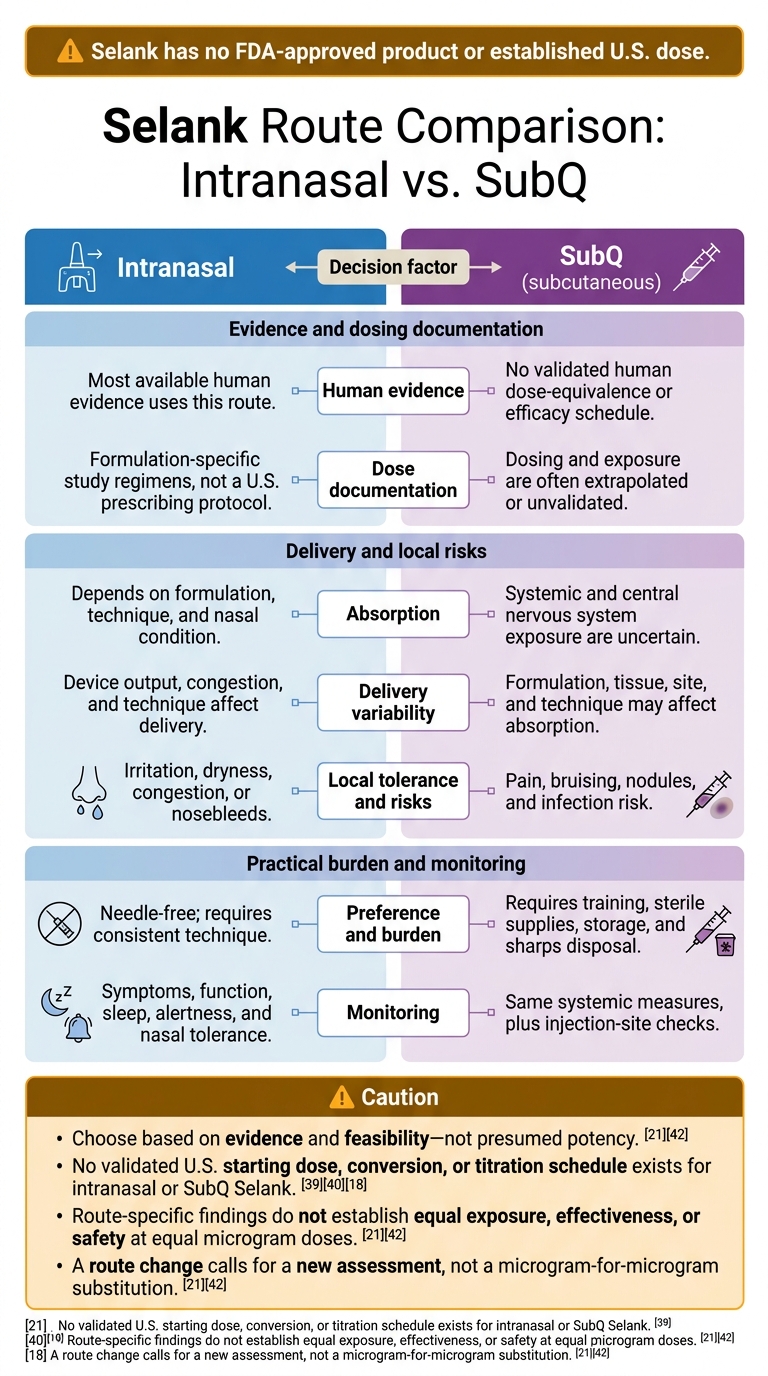
Intranasal vs. SubQ Selank: Evidence, Risks, and Monitoring
Once route-specific dosing is defined, choose the route based on the evidence, administration burden, and monitoring plan.
Intranasal vs. SubQ: Route Comparison
Use the documented baseline assessment and legal review to guide route choice. Choose based on evidence and feasibility - not presumed potency. Do not select SubQ simply because it is assumed to be more potent. A route change calls for a new assessment, not a microgram-for-microgram substitution.
| Decision factor | Intranasal | SubQ |
|---|---|---|
| Human evidence | Most available human evidence uses this route. | No validated human dose-equivalence or efficacy schedule. |
| Dose documentation | Formulation-specific study regimens, not a U.S. prescribing protocol. | Dosing and exposure are often extrapolated or unvalidated. |
| Absorption | Depends on formulation, technique, and nasal condition. | Systemic and central nervous system exposure are uncertain. |
| Delivery variability | Device output, congestion, and technique affect delivery. | Formulation, tissue, site, and technique may affect absorption. |
| Local tolerance and risks | Irritation, dryness, congestion, or nosebleeds. | Pain, bruising, nodules, and infection risk. |
| Preference and burden | Needle-free; requires consistent technique. | Requires training, sterile supplies, storage, and sharps disposal. |
| Monitoring | Symptoms, function, sleep, alertness, and nasal tolerance. | Same systemic measures, plus injection-site checks. |
Route-specific findings do not establish equal exposure, effectiveness, or safety at equal microgram doses.
After choosing the route, keep the starting plan conservative. Base changes on measured response, not expectations.
Starting Doses and Dose Adjustments
Route and dose are separate decisions. No validated U.S. starting dose, conversion, or titration schedule exists for intranasal or SubQ Selank. If treatment is justified, start conservatively, set the review interval before treatment begins, and change only one variable at a time.
Measure symptoms and function before changing the regimen, then use those same measures at follow-up. Use a validated anxiety scale when anxiety is the target, a sleep diary when sleep is the target, and one patient-defined functional outcome. Do not convert an intranasal dose into a fixed SubQ starting dose.
Change dose, frequency, route, or formulation - not several at once. Consider escalation only after confirming adherence, technique, acceptable tolerability, and a defensible reason for the increase.
Hold or discontinue treatment if symptoms worsen or adverse effects are concerning. Rather than escalating indefinitely, reassess the diagnosis, medications, sleep, and substance use. Four-weeks-on/four-weeks-off cycling is unvalidated and has not been shown to prevent tolerance.
Follow-Up and When to Stop Treatment
Set an early follow-up date before treatment starts, and repeat the review after each meaningful regimen change. Judge benefit by sustained improvement in symptoms and function, not a brief sensation.
Interaction data are limited, especially with centrally acting medications. Review antidepressants, benzodiazepines, stimulants, sedatives, and other psychoactive substances without assuming that combinations are safe.
Use the same baseline measures at follow-up to decide whether to continue, adjust, or stop.
| Assessment item | Baseline documentation | Early follow-up | Dose-change review | Action or stop criteria |
|---|---|---|---|---|
| Regimen | Route, product, concentration, dose, frequency, technique, storage, and start date | Confirm actual use, missed doses, errors, and product changes | Reconcile the regimen; change one variable | Stop and clarify uncertain labeling, concentration, or administration |
| Response | Symptom score, severity, duration, and functional goals | Track measured improvement and whether benefit is meaningful and durable | Require a defensible benefit-risk rationale before escalation | Continue only with meaningful symptom and functional benefit; reassess or discontinue if benefit is absent, marginal, or outweighed by risk |
| Neuropsychiatric effects | Sleep, alertness, energy, mood, behavior, and history of mania, psychosis, or suicidality | Assess sleep changes, activation, sedation, mood changes, and unusual behavior | Repeat screening; avoid escalation with worsening sleep or activation | Hold or discontinue for significant insomnia, agitation, or sedation; seek urgent evaluation for suicidality, mania, psychosis, or severe agitation |
| Local reactions | Nasal condition or injection-site appearance and symptoms | Assess irritation, bleeding, pain, swelling, rash, nodules, or drainage | Do not increase exposure while a reaction is unexplained | Stop and evaluate persistent or worsening reactions; seek urgent care for infection or serious allergy |
| Medications and substances | Prescription, OTC, supplement, alcohol, and centrally acting medication list | Reconcile additions, discontinuations, and timing changes | Review before attributing effects to Selank | Use extra caution with centrally acting medicines because interaction data are limited |
Stop treatment and seek urgent evaluation for suicidal ideation, mania, psychosis, severe agitation, serious allergy, suspected infection, or persistent neurologic symptoms. Breathing difficulty, throat or tongue swelling, or fainting requires emergency care - not a dose adjustment.
5. Conclusion: Clinical Checklist and Resources
Limited intranasal evidence does not support SubQ dose conversion or route equivalence. Selank remains unapproved in the U.S. Treatment decisions must meet documentation and consent requirements and comply with applicable law.
Use the checklist below to document route choice, dosing, and follow-up before the first dose, rather than relying on shared protocols.
Prescribing and Administration Checklist
Before prescribing, document the treatment goal, evidence basis, route, risks, alternatives, and legal eligibility. Informed consent records uncertainty; it does not establish safety or legal eligibility. Verify the dispensing pharmacy. Keep the prescription, label, concentration, lot/batch, quality documents, storage instructions, and beyond-use date. Resolve regulatory questions with the pharmacy, state board, or regulatory counsel before proceeding.
Record the dose (mcg), concentration, delivery volume, frequency, and planned duration. Confirm the intranasal device’s output. For SubQ, check dose-to-volume calculations (volume = dose ÷ concentration) and device accuracy, including syringe markings and reconstitution details. Document who performed the calculation and who verified it. Follow the pharmacy’s product-specific storage and beyond-use instructions - not a blanket shelf-life assumption.
Have the patient explain administration, storage, missed-dose instructions, and stop criteria in their own words, and document this teach-back. Set follow-up before the first dose and record the adverse-event reporting plan. For suspected reactions or quality problems, retain product details, dose, route, timing, treatment, and outcome. Notify the pharmacy and report through FDA channels, including MedWatch.
The clinician tools below offer calculation and documentation support.
PeptidePrescriber Resources for Clinicians
Licensed clinicians can use PeptidePrescriber for monographs, dosing tools, practical guides, and regulatory references. These tools support education and workflow. They do not validate Selank protocols, replace independent calculation checks or pharmacy verification, provide legal advice, or guarantee prescribing eligibility.
FAQs
How can I tell whether a Selank dosing claim is credible?
Check claims against primary research and weigh them against the limits of Selank’s clinical evidence. Selank is not FDA-approved, and it lacks placebo-controlled randomized trials that meet ICH-GCP standards. Most data comes from Russian studies, often with small samples.
Put evidence-based protocols first, and verify that the compounding pharmacy meets safety standards. Selank is on the FDA’s safety-risk list.
What should I ask my clinician before choosing a Selank route?
Discuss your clinical needs, the symptoms you want to manage, and any potential contraindications with your clinician. Ask about the evidence for Selank, which is not FDA-approved, and whether intranasal or subcutaneous delivery better fits your health profile.
Ask your clinician to demonstrate proper technique to help with absorption and reduce nasal irritation or injection site reactions. Share your complete medication list, especially any anxiolytics, antidepressants, or immunosuppressants you take.
How can I tell whether Selank is actually helping?
Track your symptoms over time. Anxiety relief may start within 30 to 60 minutes, while the full effects typically develop after 7 to 14 days of regular use. Watch for less anxiety, fewer neurasthenia symptoms, and possible improvements in attention and cognitive flexibility.
Results vary from person to person. PeptidePrescriber recommends reviewing your progress and any needed dose changes with your healthcare provider, as well as completing the full prescribed course.