
TB-500 is not FDA-approved, and human studies have not established that it improves mobility in older adults. My starting point: assess the cause of mobility loss, address urgent symptoms, and begin care such as physical therapy - not a peptide protocol.
In this guide, I outline how to:
- Check the exact substance and current FDA rules. TB-500 fragments and full-length thymosin beta-4 are not interchangeable.
- Track function. Record pain, joint motion, and walking or chair-rise performance, then set goals with your patient.
- Plan follow-up. Consider a safety check in 1–2 weeks and a function review in 4–6 weeks, with earlier assessment for new or worsening symptoms.
- Check sources, document decisions, and use primary studies. Use primary studies and official guidance rather than relying on peptide websites.
My bottom line: <u>monitoring does not make TB-500 safe or prove it works</u>. Keep diagnosis, rehabilitation, and the patient’s daily needs at the center of care.
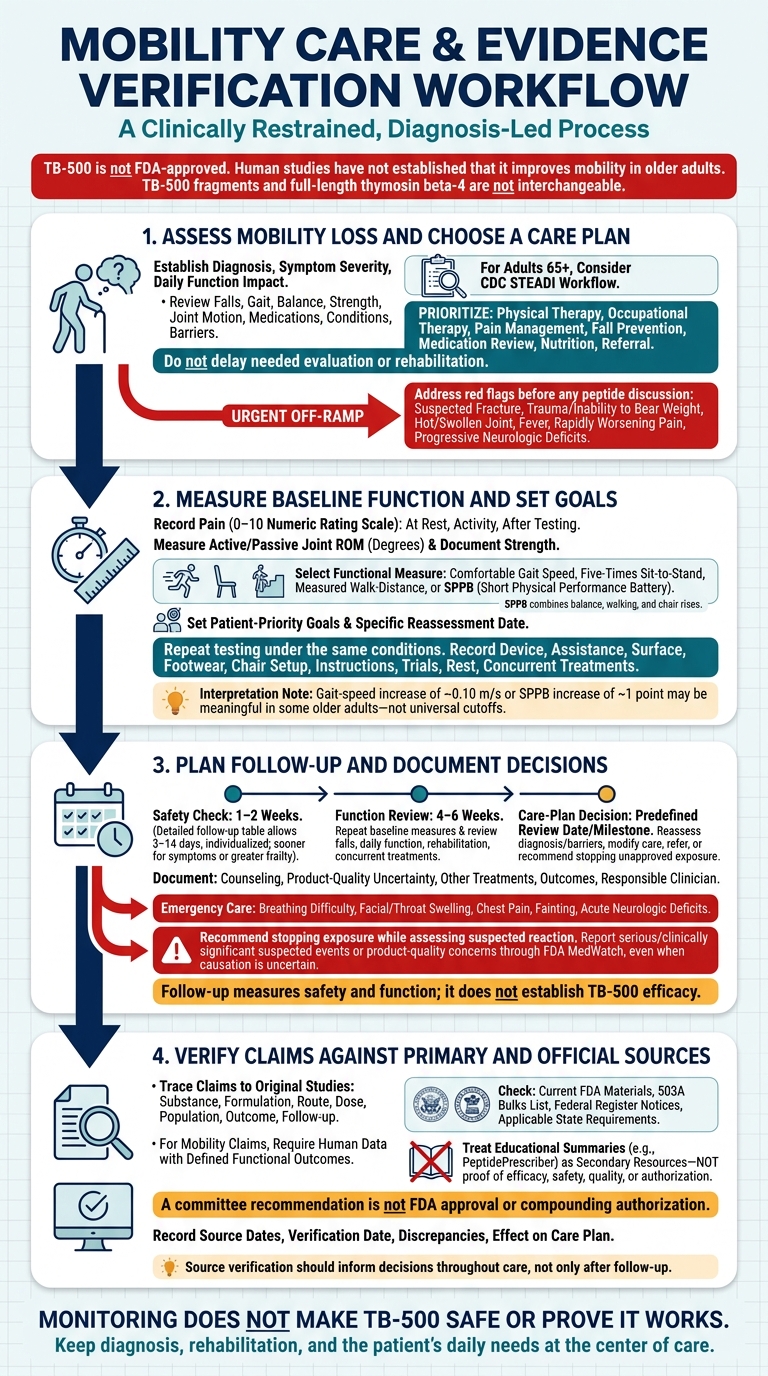
TB-500 and Aging Mobility: Provider Care Workflow
What Is the Wolverine Stack? BPC-157, TB-500 and the Evidence
sbb-itb-7164bd9
Step 1: Assess Mobility Loss and Choose a Care Plan
Before discussing peptide therapy for stiffness, reduced range of motion, or slow recovery, establish the likely diagnosis, symptom severity and duration, and effect on daily function. Then rule out urgent causes and address factors that may be contributing to mobility loss.
Check Red Flags and Contributing Conditions
Ask when symptoms started and whether they followed an injury, surgery, immobilization, infection, or gradual decline. Find out how symptoms affect walking, dressing, climbing stairs, and getting in and out of chairs.
Review falls and near-falls, walking distance, assistive-device use, activity level, sleep, and nutrition. Check for barriers involving frailty, cognition, mood, transportation, and available support. Ask about weakness, numbness, dizziness, vascular symptoms, and expectations for recovery.
Examine gait, balance, strength, joint range of motion, tenderness, swelling, deformity, sensation, pulses, and skin integrity. Check orthostatic blood pressure when relevant. For adults 65 and older, use a fall-risk workflow such as CDC STEADI to guide the review of gait, strength, balance, medications, orthostatic blood pressure, vision, feet, and home safety.
Address red flags before any peptide discussion. Investigate a suspected fracture, inability to bear weight after trauma, a hot or swollen joint, fever, wound drainage, or pain that is worsening quickly. Urgent assessment is also needed for:
- Progressive neurologic deficits, bowel or bladder changes, a cold or discolored limb, chest pain, or shortness of breath.
- Unexplained weight loss, night pain, severe pain at rest, or new vascular symptoms.
Review diabetes, osteoporosis, peripheral or cardiovascular disease, chronic kidney or liver disease, inflammatory or degenerative arthritis, prior cancer, frailty, malnutrition, and impaired wound healing.
Also review anticoagulants, antiplatelet drugs, corticosteroids, immunosuppressants, opioids, benzodiazepines, sleep medications, and antihypertensives. Treat these as care-planning factors - not validated TB-500-specific contraindications. Once urgent causes have been ruled out, match the plan to the main functional deficit.
Start With Established Care and Referral
Start with rehabilitation suited to the diagnosis. Use physical therapy for gait, strength, balance, and range-of-motion deficits, and occupational therapy for daily activities and home safety. Include appropriate pain management, fall prevention, medication review, and nutrition support. Refer to orthopedics, rheumatology, neurology, vascular care, infectious disease, or geriatrics when indicated.
Check transportation, caregiver support, home-exercise safety, understanding of the plan, finances, and access to follow-up care. Adjust the plan around these barriers. If progress stalls, reassess the diagnosis, adherence, and access to care.
Document why TB-500 came up, which established treatments were offered, referral needs, and the patient’s understanding. Do not delay needed evaluation or rehabilitation. Once the initial plan is set, record baseline function before discussing peptides further.
Step 2: Measure Baseline Function and Set Mobility Goals
Measure Pain, Joint Motion, and Daily Function
After diagnosis and initial treatment planning, record a baseline before discussing peptides. This gives you a starting point for deciding whether mobility changes enough to justify continued follow-up.
Record pain on the 0–10 Numeric Rating Scale at rest, during the priority activity, and after testing. Use a goniometer to measure active range of motion first, then passive motion, in degrees. Document the joint, movement, side, position, examiner, pain with movement, and anything limiting motion. Assess strength by muscle group and side with manual muscle testing or dynamometry.
Choose one functional test that matches the patient’s goals and starting ability: comfortable gait speed, five-times sit-to-stand time, or a measured walk-distance test. The Short Physical Performance Battery (SPPB) combines balance, walking, and chair rises.
Record the testing conditions: footwear, walking surface, assistive device, assistance level, chair height and armrests, instructions, number of trials, and rest periods. Note symptoms such as pain, dizziness, shortness of breath, or loss of balance. Also document rehabilitation attendance, home-exercise adherence, analgesic timing, and other treatments that could affect mobility scores. Repeat testing under the same conditions so the comparison is valid.
Set Goals, Review Dates, and Action Thresholds
Choose goals that matter to the patient, such as safer bathroom transfers, walking farther at home, or standing long enough to prepare a meal. Give each goal a measurable target for the next review visit.
Domain Baseline Target Testing method Reassessment date Right knee active flexion 92°; pain 6/10 at end range 110°; pain no higher than 4/10 Goniometer, seated, same examiner and position 4 weeks Comfortable gait speed 0.52 m/s with cane 0.62 m/s with cane and no loss of balance Timed 4-meter walk; fastest of two trials 4 weeks Five-times sit-to-stand 24 seconds using armrests 18 seconds without arm use Standard-height chair; timed single trial after practice 4 weeks Walking tolerance 120 feet with rolling walker 300 feet with usual device and standby assistance or less Measured indoor corridor; record symptoms and rests 6 weeks Shower transfer Requires assistance Completes transfer with grab bar and supervision Structured functional observation 6 weeks
Use validated meaningful-change thresholds for the selected test and patient population - not arbitrary percentages. A gait-speed increase of about 0.10 m/s or an SPPB increase of about 1 point may be meaningful in some older-adult populations, but neither is a universal cutoff. Check measurement variability and other treatments before interpreting a change.
Schedule a safety check in 1–2 weeks and a function review in 4–6 weeks. Arrange an earlier assessment for worsening pain, new weakness or sensory loss, falls, swelling or redness, fever, allergic symptoms, injection-site complications, dizziness, shortness of breath, chest pain, or declining function. Use implementation tools and consent forms to standardize these safety checks.
If the selected measure has not improved by the agreed review date, reassess the diagnosis, rehabilitation access and adherence, medication effects, and referral needs. Do not presume TB-500 benefit.
Step 3: Plan Follow-Up and Document Care Decisions
Schedule Safety Checks and Function Reviews
Once baseline goals are set, schedule follow-up using the same measures of function, safety, and tolerance. Follow-up measures safety and function; it does not establish TB-500 efficacy. Name the person responsible for each contact and record an exact appointment date - not simply “return as needed.” Follow the predefined review date or protocol schedule.
| Review stage | Individualized timing | Assessment | Action |
|---|---|---|---|
| Early safety check | Within 3–14 days; sooner for symptoms or greater frailty | Adverse symptoms, injection-site findings, medication changes, and patient-reported product details | Arrange an examination or urgent care when indicated; follow study reporting procedures when applicable |
| Function review | Around 4–6 weeks | Repeat baseline measures; review rehabilitation, concurrent treatments, falls, and daily function | Determine whether function is improving, stable, or worsening; address barriers to rehabilitation and modify established care |
| Care-plan decision | At the predefined review date or protocol-defined milestone | Compare progress with goals, adverse events, and other explanations for change | Continue care, intensify rehabilitation, refer, reassess the diagnosis, or stop unapproved exposure |
Connect each visit to the patient’s mobility goals, new symptoms, and any decline.
Plan Responses to Adverse Events and Deterioration
Direct patients with breathing difficulty, facial or throat swelling, chest pain, fainting, or acute neurologic deficits to emergency care. Promptly evaluate suspected infection, hypersensitivity, systemic illness, new neurologic findings, repeated falls, severe dizziness, or marked functional decline - especially when mobility worsens. Recommend stopping exposure while assessing a suspected reaction.
Report serious or clinically significant suspected events or product-quality concerns through FDA MedWatch online or Form 3500, even when causation is uncertain. For patients enrolled in an authorized study, immediately follow the study’s adverse-event, unblinding, and investigator-reporting procedures.
For independently obtained products, record the patient-reported product name, label, source, lot or batch number, expiration date, concentration, storage conditions, reconstitution details, injection technique, route, dates and amounts used, and remaining material. Retain packaging according to practice policy and note any missing information. Document that the product’s identity, sterility, potency, quality, and legal status were not independently confirmed. Monitoring does not make continued exposure safe.
Document each decision during the same visit in which you review safety and function.
Document Counseling, Other Treatments, and Outcomes
Record the diagnosis, differential diagnosis, baseline findings, and counseling about uncertain benefits, incompletely characterized risks, product-quality concerns, and regulatory limits. Include established treatment options, the patient’s questions and understanding, and consent or refusal. Record relevant costs in U.S. dollars and clearly label costs reported by the patient. Consent and monitoring do not establish efficacy, lawful access, FDA approval, or a favorable benefit-risk balance.
At review, mark each goal as met, partially met, unmet, or unable to assess, including the patient’s mobility goals. Account for rehabilitation, analgesic changes, activity, illness, and natural recovery before attributing any change to exposure.
Explain decisions to defer investigational use, recommend discontinuation, refer, or change established care. Sign and date the note, name the clinician responsible for follow-up, and keep dated, version-controlled FDA, state, institutional, and protocol references.
Step 4: Check Educational Resources Against Primary Sources
Before using an educational summary, trace each claim to the original study. Check the substance, formulation, route, dose, population, outcome, and follow-up period. Reject summaries that cite molecules, routes, or outcomes that don’t match the claim.
For mobility claims, require human data with defined outcomes, such as gait speed, timed-up-and-go, or joint range of motion. Look for newer primary research, too. Don’t assume an educational summary is up to date.
Once you’ve checked the primary evidence, use secondary resources only to organize your review.
Use PeptidePrescriber as a Secondary Resource
Use PeptidePrescriber monographs, protocols, calculators, and injection guides to organize your review - not as proof of efficacy, safety, quality, or authorization.
Check regulatory summaries against current FDA safety materials, the 503A bulks list, Federal Register notices, and applicable state medical- and pharmacy-board requirements. A committee recommendation is not FDA approval or compounding authorization. Ask the dispensing pharmacy to identify its legal basis for supplying the exact substance. A listing or sourcing recommendation isn’t enough.
If a secondary resource conflicts with official requirements or primary evidence, stop and resolve the discrepancy. Record the claim you checked, the source title, its publication or update date, your verification date, and how the finding affected the care plan. Use the protocol to trace the reasoning - not to replace missing evidence.
Conclusion: Put Diagnosis, Function, and Safety First
For older adults with stiffness, limited range of motion, or slow recovery, TB-500 remains investigational. It is not FDA-approved, and there is no direct human evidence that it improves mobility.
Track pain, joint motion, and walking or chair-rise performance under the same testing conditions. Pair these measures with care guided by the diagnosis: rehabilitation, medication review, fall-risk reduction, and referral when needed. Set goals that reflect the patient’s priorities and choose a specific review date. Adjust follow-up based on patient selection criteria, frailty, other health conditions, and treatment changes. Reassess sooner if function worsens or new safety concerns arise.
Document the discussion of evidence, patient preferences, treatments used, objective outcomes, and reasons for any change to the care plan.
FAQs
Can thymosin beta-4 studies support TB-500 mobility claims?
No. Studies of thymosin beta-4 do not directly support clinical mobility claims for TB-500, a synthetic fragment of that molecule.
Evidence for TB-500 comes largely from animal and laboratory studies. There’s no established human dose, and no randomized controlled trial data validate its use for mobility, stiffness, or range of motion in older adults.
Clinicians should treat TB-500 as investigational - not assume that findings about thymosin beta-4’s efficacy or safety also apply to TB-500.
How can I distinguish rehabilitation gains from possible TB-500 effects?
Document all treatments used alongside TB-500, including physical therapy, procedures, and activity changes. Track progress against baseline measurements for range of motion, strength, and pain, using a 0–10 scale for pain.
TB-500 is an add-on treatment, not a stand-alone treatment, so don’t assume the peptide alone accounts for any gains. If improvement continues while rehabilitation stays consistent, record all clinical variables to help interpret those changes.
What should I do if a patient already uses TB-500?
Review the patient’s medical history, why TB-500 was started, the dose and source, and the clinical response. Check for contraindications, including active malignancy or a history of cancer within the past five years.
Document the product’s identity, lot number, and storage conditions. These details do not guarantee safety or quality. Record baseline pain scores and range of motion, set clear clinical goals, and schedule a reassessment date to check progress.